Law and Mental Health: Artificial Intelligence (AI) and Research
February 24, 2026
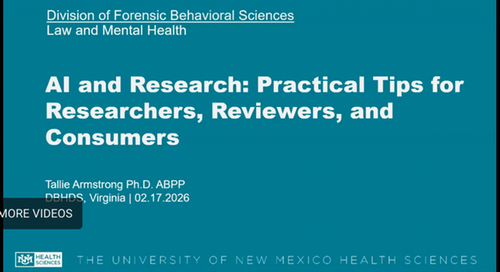 Law and Mental Health: Artificial Intelligence (AI) and Research: Practical Tips for Researchers, Reviewers, and Consumers -Natalie Armstrong, PhD, ABPP Dr. Armstrong received her doctoral degree in clinical psychology from Sam Houston State University.
She completed internship at the Eastern Virginia Medical School, and a postdoctoral fellowship in forensic psychology at the Medical University of South Carolina. She obtained board certification in forensic psychology in 2024. Dr. Armstrong is licensed in Virginia and Massachusetts and is also certified through PSYPACT (APIT and TAP).
Her professional career centers on public sector forensic evaluation work and developing research infrastructure for large organizations. Her private sector work focuses on civil forensic evaluation work with families and juvenile forensic evaluations. She is currently a forensic psychologist and Chair of the Institutional Review Board for the Virginia Department of Behavioral Health & Developmental Services. Research interests include quality of forensic report writing, disseminating information about forensic assessments in strict security settings, and the impact of ethics and Artificial Intelligence on forensic psychology.
Learning Objectives:
- 1. Describe the scope of AI interfacing with psychological research.
- 2. Analyze how AI may be used to effectively augment psychological research.
- 3. Discuss instances when AI may be ineffective or unhelpful to research.